Stories, poems, and other things that found their way onto paper.
Poetry
Cat Allergies
Always shy to start my poems
Always shy to use your name
Perhaps the darkness might not call to you
The way it calls to my cat
But I think you two
Would be great friends
When the bluestones started breaking
Like glass in your palm
Leaving scratches
I kept thinking you look like
Someone who might own a cat
But now you sneeze
With no breaks in between
And I know
The two of us
Could never be the closest of friends
If you are allergic
To all I have ever been
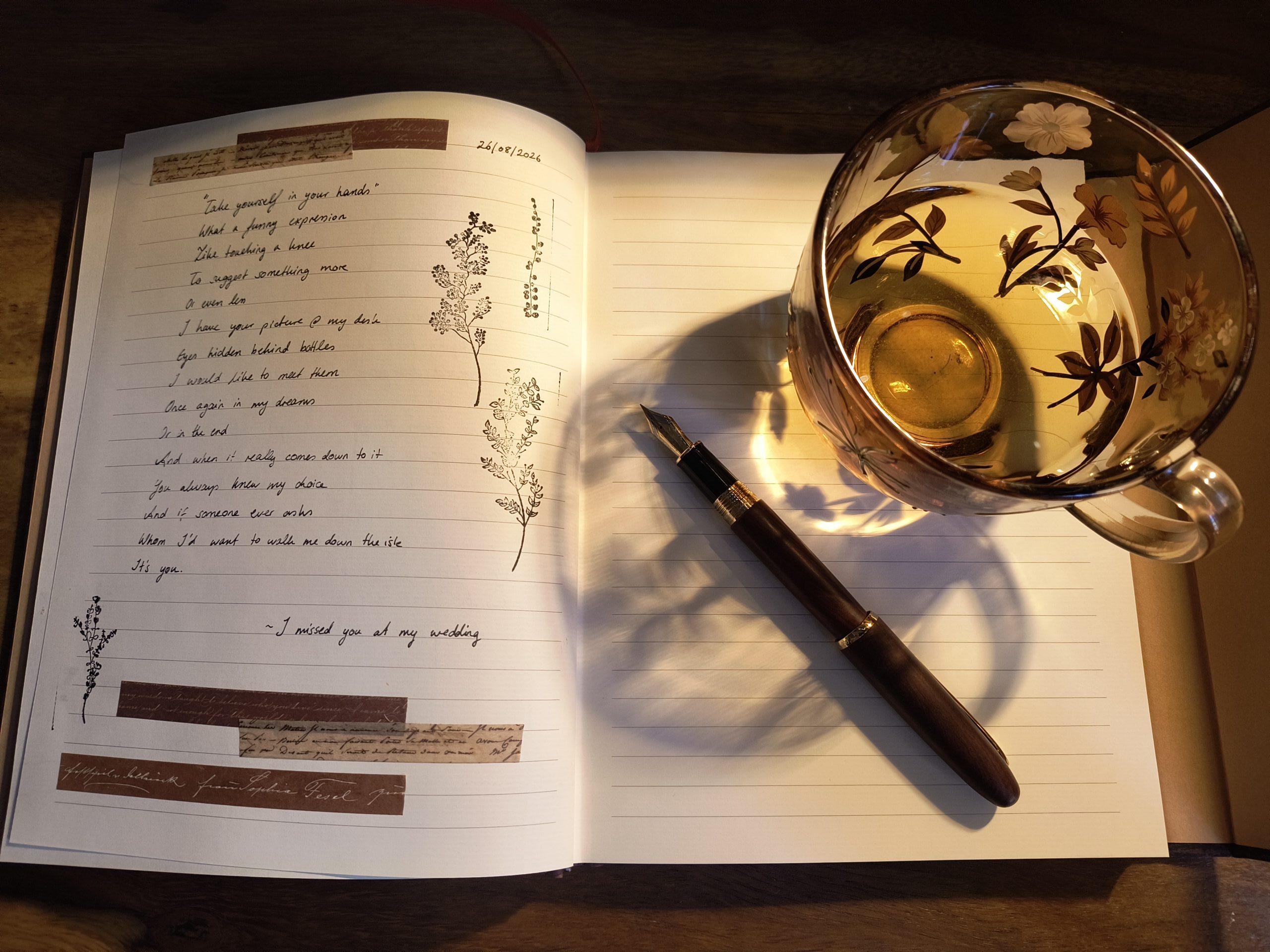
Birches and Pines
Perhaps when the sun does set
And the leaves all fall in vibrant colours
And upon our lives
Is a stillness
Of the close
Perhaps then you and I
Will meet again
Under birches and pines
Gathering spiderwebs
Or whatever the fuck it was we did
When I was too young
And you were too old
For us to not have to part
Illustration Ski
Sibling Souls Lost in Limbo
Misunderstandings every step of the way
Step, step, step.
Sibling souls lost in limbo
Circles or spirals
I can never really tell
Have we been here before
Or is this evolving
Inwards
To what should have been the start
Step, step, step.
In one place, stomping with frustration
I don’t want to
You don’t want to
When did life
Become this tight
Pulling at my hair
Pulling at your limbs
Step, step, step.
Stop and breathe with me
Tell me where you’re heading
I will follow in reverse
Step, step, step.
Now stop running, I can’t breathe
I haven’t breathed in ages
The air a vacuum hole
Filled with dust and crumbs of secrets past
Step, step, step.
No matter the direction
I always feel like returning
To the same door
I never dare to open
Short Stories
Vermont
Vermont
There isn’t enough room in this air. It has a certain something to it, like insects sliding through it, cutting the entire space, cutting the time, cutting everything that even remotely feels. A small caterpillar is on the edge of the air, and I have already written about that, I have said that, a few times, a few too many times. There is a small bee, or is it a spider? Maybe it is a wasp. Wasps look like both, like spiders and bees, and they take up the air in a room or the room in the air or simply space in here and time. I wonder when it will move. When it will all spiral down there in form of worms and caterpillars and things that slide and crawl and move and wind through the darkness down into the room I used to call air, used to call something that once might have mattered in a distinct room, in a space, in a time when it was still filled with insects. But now it’s different and the darkness might have been there or not, I can’t really place it.
She was different back then.
The houses still look like they did in a moment in time when I couldn’t see them. It was a weird sensation, as if someone had plucked out my eyes, maybe stabbed at them with a stick. No one had, obviously, but it felt weird to have the eyelids open and not see. To be fair, someone had poked at them. With some instrument I forgot the name of. Operations. Necessary back then. She told me to do it so I could see the clouds shaped like pigeons in the sky. I never could. Not even now.
She used to wear a smile on her wrist.
I am watering my plants for the third time this week. It hasn’t been this hot since February. My balcony potato has died. I always want to smoke when I water my plants because the balcony smells like it used to when I smoked. I live in the past, they say. But I don’t live in time. I live behind my balcony. I live behind the plants. I live where I get the water to water them and where the balcony smell can’t reach me. I don’t live in time. They lie. They always lie about where I live, about what I do, about balcony potatoes not being able to die. She has died. My balcony potato has died. Maybe the smoke was better for her than the water. Maybe I should have saved my saliva every time I smoked, spit it into a jar, gathered it and now I should be watering my balcony potato with it. Maybe it would have changed the course of her pathetic and way too sentimental existence. Maybe she could have lived in time, like others say I do. But I don’t. And now, neither does she.
She would hold my pinkie on the escalator whenever it went down.
From where I stand, I can’t see the mountains. I can see the fields below, the grass, green and beige and ochre and yellow and brown and all the colours I have never liked. I can see the houses or the cubes or the triangles or the circles or whatever they have tried to represent and I can see the clouds of brown coming out of them. Another colour I have never liked. I have already said that. I have said that I don’t like that colour. Why won’t she believe me? I can see the sky, and it is longer and taller today, and broader and maybe somehow even bigger, circling above my head like a bird in almost white, blinding the eye I have lost. I don’t like white either. Maybe I don’t like colours at all cause I have never seen them and then I did and then people don’t like changes or experiences that haven’t been rewarding or beautiful or painful. But people. Not me. I don’t like colours. I don’t like white and brown and beige and ochre and green and brown again and white again and especially yellow because yellow sounds like a million birds vomiting onto the mountains I can’t see.
I never fell down.
We once went to Vermont. I was younger then, young enough to look at her and to still know where Vermont is. It sounds like a made up place now, like I’ve never been there. Like no one has seen me there.
We once went to Vermont and the trees were so tall I felt like I could climb them, and she said I could and so I did and I scratched both of my knees and my left elbow and somehow the scratches got bad and we went to the hospital and the scratch on my left elbow hurt so much for a few weeks she had to leave me.
We once went to Vermont and the moustache I wore would tickle like leaves in the breeze. She would laugh and then yell and then run away, her dress flying behind her like a white flag, like surrender, like take me, take me, take me. And then the laugh would echo from the walls of the place we stayed in, and it wouldn’t stop echoing, even when all the glasses broke in the storm.
We once went to Vermont and I couldn’t stand the heat and so I took a bath so long I couldn’t feel my fingertips cause they disgusted me so much and she must have sucked or kissed or licked them and it made it worse.
I never showed her my birthmark.
The little bell we had would ring twice a day like the cry of a dying animal. It would ring when I came there and it would ring when I left. And I did both twice a day. I only do it once now. I only leave. I leave once a day but I never come. And the bell still rings but it is quieter now, and it still reminds me of the snow, of how my boots would wet the hallway floor, of how the snow was so deep once her shoe got stuck and I had to carry her past the little bell and it wouldn’t stop screaming, it would keep dying and dying like a deer shot in the leg, the snow white as heaven with that brown shoe somewhere inside of it.
The printer broke before I could write the letter.
My glasses broke like they did in Vermont. They broke that day, when the clouds might have been shaped like pigeons or the bells might have cried and the room got thinner the way air slides into spaces it shouldn’t be. The wrists were entirely gone and so were the colours I had never liked and the time people said I could have lived in. And the houses looked all different and then new and then the potato on my balcony started blooming and now it has died and I have always wondered how she could live where I couldn’t and how now she can’t. The insects are crawling through it now, through the time and the space and the edges of it, through my balcony potato and through the glasses and wrists and pinkies and birthmarks and I still can’t see the mountains, and I still can’t see the clouds, and the printer we had in Vermont was unfixable they said at the store. So I never wrote a letter. As if I had never been there. As if no one had seen me there. As if the smile had never turned too red.
Seabirds
Sea-birds
The fishermen had all left already and the dock was deserted. The sun hadn’t risen yet. The last moto-taxis were riding off in the distance. There was a quietude, nothing but the wind and the splattering of the water against the wooden pillars, but Pedro knew that the noise would be back in two hours when the fishermen would come in with their catches, at first silent silhouettes far out on the water, then he would be able to hear their quiet conversations, and then their loud chatting when they would get out of the boats and arrange the fish for the people to buy. Then the dock and the street to it would be filled with shouting, trading, shoving people, and Pedro would stay for a little bit to talk to José before making his way down the shore back to his cabaña.
But it was still quiet. All of that was in the future, and Pedro awaited it anxiously, but for now it was quiet and it would stay that way for a few hours. It was cold, too. The morning heat would come with the rising sun.
When Pedro was little, his father would take him to this place. Sometimes he would even take Pedro on his boat with him, and they would fish together. It was a quiet business. The men would throw in the nets and wait. Sometimes Pedro’s father would smoke his pipe. On those days, when the pipe was lit, more fish came in. And when Pedro’s father didn’t smoke, there was less fish. Pedro had never been quite sure whether his father smoked when he knew that much fish would come in or whether the fish came in because his father was smoking. At first he thought the pipe was a lucky omen, but as he watched his father light it, his moustache covering the tip and his eyes squinted, the pipe seemed too concrete, too palpable to be of anything mysterious or divine.
Most things were like that for Pedro. There was always something about things that took their mystery, that made them too real to assign them a religious meaning. Even the crosses in the church at the plaza weren’t mystified anymore. Pedro made the mistake of touching them once. The wooden cross left a splinter in his thumb, a small one, yet enough to be felt. The golden cross was so cold it startled him. He stopped going to church ever since.
The waves were getting stronger now. The tide was coming in, and with it the fish would come. Pedro wondered whether he would bet again with himself. Would there be a lot of fish today? Or just the average that sold out in one hour? Or would there be less than usual, leaving the fishermen annoyed for the rest of the day? This was a fisher’s town. If there was no fish, the whole town would be annoyed, for the wives of the fishermen would be annoyed by their annoyed husbands, and the boys would be annoyed because their mothers wouldn’t let them play at the beach because they were annoyed. Pedro betted on a lot of fish today.
“Señor!” Someone was running up the dock towards Pedro. It was a man, Pedro saw as he came closer. He wasn’t from here. There was a thick American accent in his pronunciation, a blond mop of hair under his hat, and freckles all across his face. He was slightly hunchbacked, and one of his knees seemed to bend lower than the other as he moved.
“Señor, perdon, los… los muchachos con el pescado salen?” He asked, his pronunciation so horrible that Pedro needed a moment to understand the question.
“Yes. The men leave. It is late.” Pedro answered in English. He was probably the only one on this coast all the way down to Lima who spoke English. He had learned it in Cusco, back when he went to university. The plan was to stay out there and teach. But his roommate used to pee in the sink at night. So he came back here, and put his degree into the cupboard in his little cabaña.
“Oh, you speak English! What a bliss! I was so lost, everyone always speaks so fast and you know what it’s like, when they all shoutin’ and yellin’ at you and you’re –“ The man gesticulated to portray his despair.
“Yes.” Pedro nodded.
“What a shame they left. What a shame. I thought they left at five, I’m sure they said five yesterday evening.”
“Four. Always four.” Pedro said, turning away from the man.
“Are you a fisher as well? Yes, you look like a fisherman. I really like that beard of yours. I always try to grow one but I get too impatient.” The man walked around Pedro to face him again. “Listen, do you have a cigarette by any chance?”
“No.” Pedro answered all the open questions with one word.
“That’s a pity. I’ve been dying to smoke one. So, listen, when do they come back from out there? The fishermen, I mean?”
“Another two hours. Maybe seven, maybe eight.”
“And you’re waiting here for them? It must be cold, right?”
“No.”
The man was silent for a moment. The waves were even stronger now, the wind blowing harder. The first seagulls were soaring above the ocean. The sky was a bit brighter now, and Pedro could see clouds in the distance. They would disappear soon.
“You ever got married?” The man asked.
“No.” Pedro answered.
“That’s good. Wives are a pain in the ass. That must be why you are patient enough to grow a beard. There is no woman to make you impatient.” The waves were slamming forcefully onto the shore now. Today would be windier than yesterday. Pedro still stayed with his initial bet, more fish today. “I have a woman back home in the states. She cries a lot. Always actually. She dropped a plate the other day and called me crying. I don’t know what to do with her.”
“Is she beautiful?” Pedro asked.
“Pretty, yes. Very pretty.” The man said.
The seagulls were getting closer to the shore now. The first ones started landing on the beach. They knew, too, that the fish would come in soon with the fishermen.
“Anyways, hasta luego.” The man said and walked away back to the streets. The first moto-taxis were waiting there.
Pedro looked after him for a while, then turned his attention to the houses lining the shore. The sun was coming up now and the houses stopped being grey, the colours came back in, the white and the brown and the blue. He could see his own little cabaña from here.
He could also see the dark grey water now. And the tiny black spots in the distance, barely moving, yet coming closer and closer with every passing minute, carried by the wind and the waves. The fishermen were coming back home.